
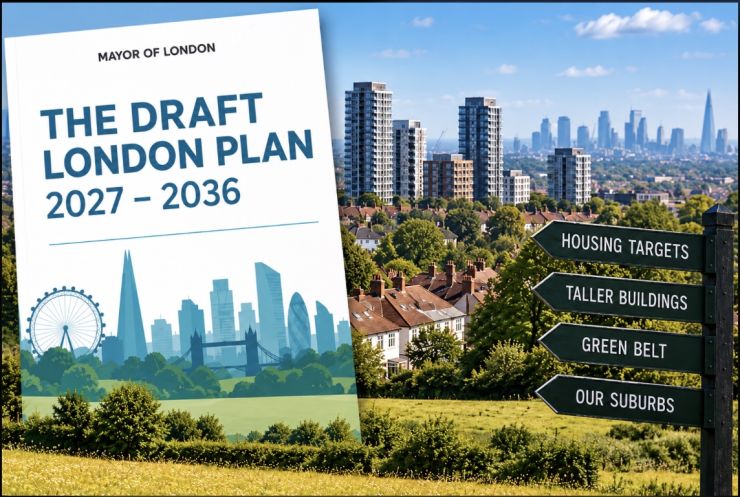
THE DRAFT LONDON PLAN 2027 – 2036
Are you looking for a really depressing read? If so we strongly recommend this document which can be found at https://consult.london.gov.uk/londonplan
The key content is the section on housing, in which one paragraph (395) succinctly explains what we can expect. It says “The majority of need lies in one and two bedroom homes for those wishing to form new households or downsize. The need for larger homes is significantly lower overall”. This translates as justification to build vast numbers of tiny flats in tower blocks. The refence to downsizing is poppycock. Older people thinking of downsizing will for sure spurn tiny flats in tower blocks. It continues to be the case that there is no strategy for providing low-rise quality developments of flats that older people might find acceptable.
The targets are astonishing. Over ten years from 2027 Boroughs are tasked with delivering 558,000 homes, though they will have to aim for 850,000. These homes are expected to be in well-connected locations which can include Green Belt.
To achieve these targets definitions for tall buildings have been revised to make approvals for those up to ten storeys much easier. In the current London Plan a tall building may be defined as seven storeys or more, with Councils required to designate areas where they would be suitable, as indeed Barnet has done in its current Local Plan. But with a sleight of hand, in future buildings of five to nine storeys will be classified as ’mid-rise’ with no restrictions on where they might be built. We are told that by’ optimising’ land use there will be more mid-rise buildings, implying encouragement to demolish existing houses and replaces then with flat blocks up to nine storeys. This is a potential disaster for our suburban streets. There is of course nothing in the Plan recognising the importance of middle-income families as the bedrock of suburban life. They appear to be viewed as no more over-privileged property owners sitting on large plots suitable for ‘intensification’.
And they way is being paved for even taller buildings. Buildings ten to thirty storeys will be designated as ‘tall buildings’, whilst those over thirty storeys will be called ‘tall metropolitan’. The current figures for these are astonishing. Up to the year 2000 there were only 23 buildings that fitted the ‘tall metropolitan’ definition, now there are 134, with a further 199 having planning consent. Existing buildings fitting the ‘tall buildings’ definition total 644. We can expect vastly more. Though councils will still have to designate localities suitable for buildings over ten storeys, the only controls proposed are that they should “fit into the skyline and respect the area and nearby buildings”. ‘Fit’ and ‘respect’ are requirements that will be wide open to interpretation, and not in a good way. We know this from the proposed eleven storey monstrosity at High Barnet station described by the developer, and endorsed by Barnet and GLA planning officers, as an ‘iconic’ building that will enhance the area.
The long-standing obsession of the Mayor to reduce car use and extend use of public transport or cycling and walking continues as a major objective of the new Plan. To date this has indeed been largely successful in central London but a dismal failure in the suburbs. An understanding of aspirations and travel patterns in the suburbs explains why this policy is likely to fail yet again, and this is despite an expectation that new developments everywhere should be car free.
Barnet has emerged as the Borough with the largest target for new housing – 32,730 over ten years, including 7,000 on Green Belt land. Next are Ealing with 32,054 and Greenwich with 27,850. Just twelve of the thirty-three Boroughs have targets over 20.000, including just eight expected to use Green Belt land. Particularly ominous locally is the statement that High Barnet station is said in to be in a Green Belt area described as “a broad location for growth.” We remain unclear as to precisely what this means.
Is there any reason for optimism? One glimmer of hope is that the Plan acknowledges the possibility of the creation of a regional park in the north of the Borough, which would include undeveloped land immediately adjacent to High Barnet. We can also take comfort from the dismal failure of the current London Plan to deliver anywhere near its housing targets, with new construction having currently just about ground to a halt. There are several reasons for this, but constraints such as securing the necessary land, ensuring that schemes with a high proportion of ‘affordable’ homes are viable, the capacity of the building industry to deliver, and fierce local opposition, are all likely to persist. The targets in the new Plan are equally likely to turn out to be just as fanciful as those in the current one.
But for sure the inner London mentality of the Mayor and the GLA sees urbanisation as the future for the suburbs, with scant regard for the lifestyle and aspirations of the vast numbers of middle-income families who live here. Pessimists amongst us might have regard to lines from one of Philip Larkin’s most famous poems:
Man hands on misery to man
It deepens like a coastal shelf
Get out as early as you can